Tools
Practical tools for connected work.
Structured Collaboration comes with a small set of canvases, developed and tested inside real organisations. Each one makes visible something that usually lives in people’s heads: how the business executes, how teams depend on each other, how strategy reaches a named person, and what the Forum decided.
© Alex McDonnell
Across the business · The Agile Business Execution Canvas®
One picture of how the business turns strategy into execution.
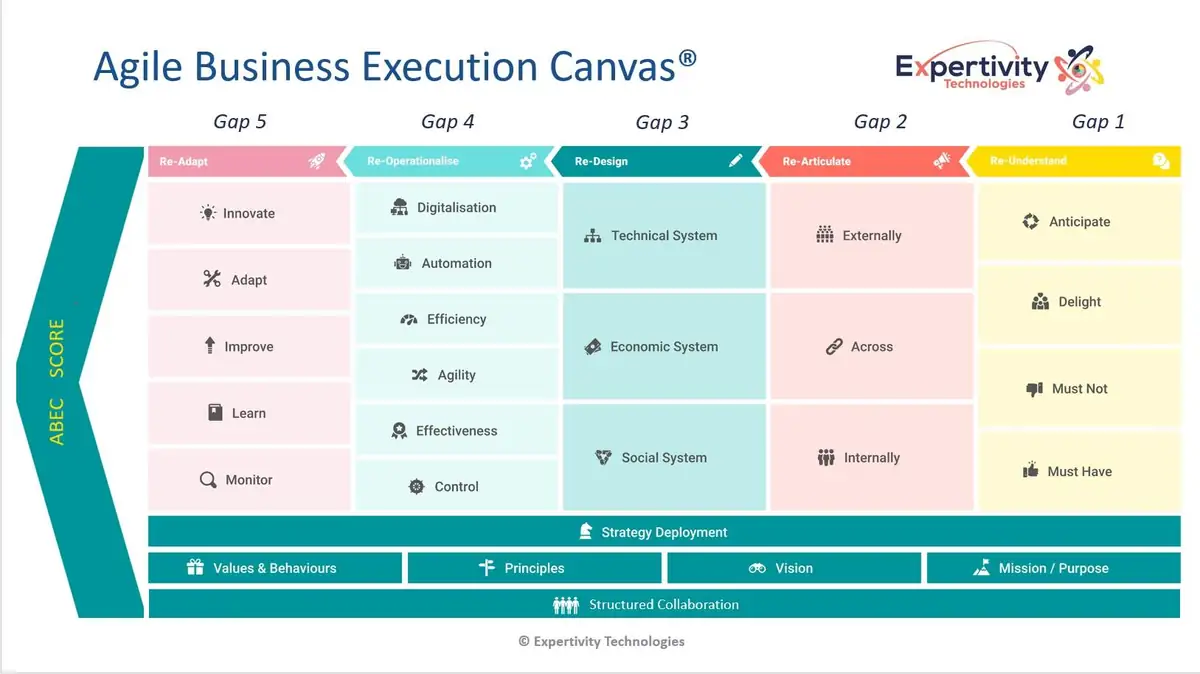
Most organisations aren’t designed as a whole. They grow a team, a function and a process at a time, and the logic that should connect them stays implicit. The Agile Business Execution Canvas® makes it explicit: how purpose becomes work, how decisions are made, how value flows and how the organisation learns.
It works the same way at every level. An enterprise, a function, a process and a single team can each have a canvas, built on the same logic, so decisions made in one place reinforce the others instead of contradicting them.
How it’s built
A platform of mission and purpose, vision, values and behaviours, principles and strategy deployment, resting on Structured Collaboration.
Five pillars that run as a continuous cycle:
- Re-Understand: what customers need, what they must not get, what would delight them and what’s coming.
- Re-Articulate: how the organisation works, explained internally, across teams and externally.
- Re-Design: the social, economic and technical systems.
- Re-Operationalise: control, effectiveness, efficiency, agility, automation and digitalisation.
- Re-Adapt: monitor, learn, improve, adapt and innovate.
The ABEC Score
Each pillar closes an execution gap, numbered from Gap 1 (understanding) to Gap 5 (adapting). The ABEC Score rates the canvas’s 27 components from 1 to 10 to show where execution is strong, fragile or missing. The pattern matters more than the total: an organisation that scores well on operations but poorly on understanding is simply getting more efficient at the wrong things. The guides explain how to run the score in practice.
Where it came from
The canvas began as the Business Execution Canvas, in Alex’s doctoral research at the University of Limerick, a professional doctorate in engineering that COVID interrupted before it was completed. Reviewing the research on business models, he found an execution gap: the models describe what a business intends to do, but say almost nothing about how it will actually deliver. The Business Model Canvas had made strategy visible; nothing did the same for execution.
The original five pillars, Understand, Articulate, Design, Operationalise and Monitor, are still recognisable in today’s canvas. Years of use inside real organisations turned them into a continuous cycle and added the platform they rest on.
Between teams · The Structured Collaboration Canvas®
Agree how teams connect, then keep it current.
If the Agile Business Execution Canvas® is the architecture of execution, the Structured Collaboration Canvas® is its conversation. It captures the working logic of one relationship: what flows in, what flows out, to what standard, and what happens when something goes wrong.
It isn’t a one-off workshop output. Teams come back to it when priorities, people or systems change, and use its parking lot to capture the issues and ideas that come up along the way.
Five questions
- Who depends on us?
- What do they need from us, and to what standard?
- What do we do to provide it?
- What do we need in order to do that well?
- Who do we depend on for it?
The blank canvas, for an individual or a team. On a small screen, scroll sideways to see all of it.
“Execution is not magic; it is design.”
Every tool on this page does the same job. It turns an unspoken assumption into an agreement people can see, test and improve.
From strategy to the team
Three more canvases, one logic.
These carry direction down to the work, and decisions back up to the people who need to make them.
Strategy
The Strategy Deployment Canvas
One page that runs from mission and vision through breakthrough goals and near-term priorities to a named leader and a dated activity. It’s built through dialogue across levels, not handed down, so the commitments are realistic and owned.
Teams
The Team Canvas
A canvas for every team, within one organisation. Each team sets out its purpose, the strategic objectives it contributes to, what the organisation’s values mean in its daily work, and who it depends on, so it can act with autonomy while staying tied to the whole.
Senior teams
The Forum Decision Canvas
A record of what the Enterprise Execution Forum decided, who owns it and when they report back, so decisions are acted on rather than argued over again.
The detail that matters
Operational definitions.
Words like “complete”, “approved” and “on time” feel clear until two teams discover they meant different things.
That’s why every input and deliverable on a Structured Collaboration Canvas® needs an operational definition: a plain statement of what counts, and how you’d check. A good one passes a simple test. Could two reasonable people apply it independently and reach the same conclusion?
One chain, not five documents
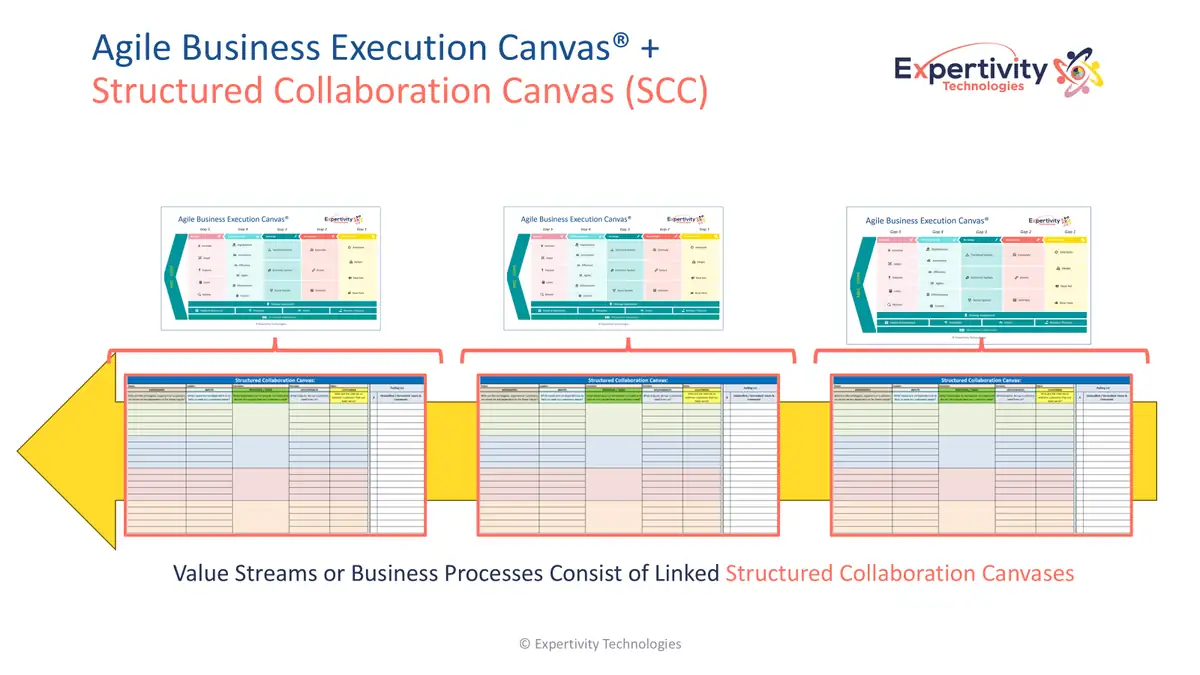
A value stream is a chain of linked canvases.
The canvases aren’t separate paperwork. The Agile Business Execution Canvas® sets the architecture. Each handoff along a process or value stream, such as lead-to-cash, gets its own Structured Collaboration Canvas®, linked to the next. Strategy flows down through the Strategy Deployment Canvas and team plans; issues a team can’t resolve flow back up to the Forum.
Get the tools
Free guides to every canvas.
Practical guides to the Agile Business Execution Canvas® at each level, the Structured Collaboration Canvas®, strategy deployment, and the Manifesto for Organisations with a Modern Workforce. Free when you register with your email.
Start a conversation